
Can Technology Reduce the Influence of Money in Politics?
When voters and their smartphones matter more than big money donors and TV ads

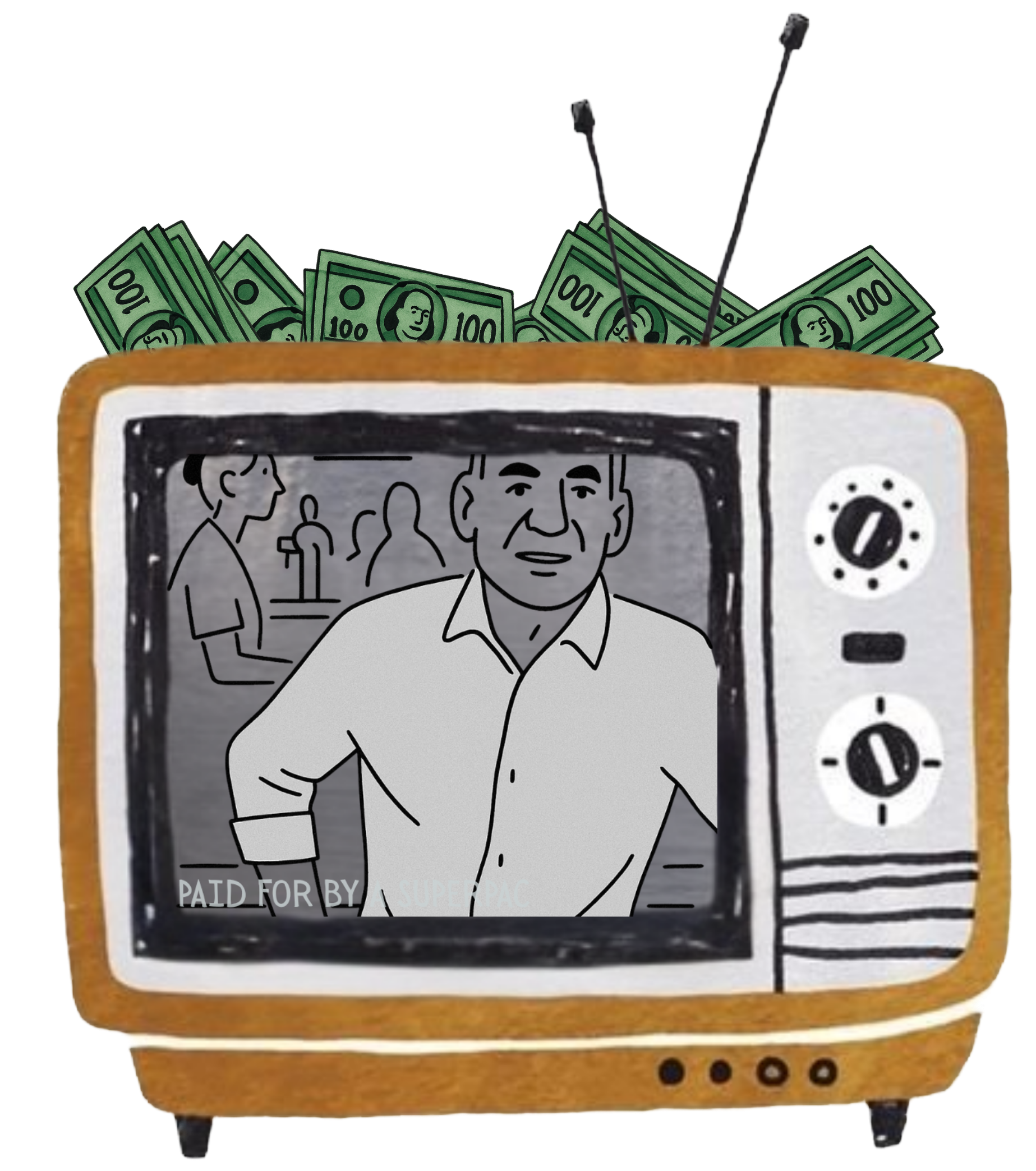
When you ask people to diagnose why our political system is so broken, “money in politics” is typically one of the first answers you’ll get. With good reason – on average, between direct and indirect sources, in 2024, nearly $16 billion was spent just on federal elections alone.
When you combine that staggering amount of money with both the impact of gerrymandering and the impact of pathetically low turnout in most primaries, special interests who have the ability to spend a lot of money have a real advantage. However, thanks to two advances in technology, I believe that the role of money in politics is starting to change and the need for money in politics may start to ultimately decline.
Look at both last week’s contest for mayor in New York City and last year’s presidential election. In each case, the candidate on whose behalf the most was spent lost. Between independent expenditures and the campaign itself, Andrew Cuomo spent as much as $70 million pursuing the mayoralty (final totals are not yet available), with the vast, vast majority of that money spent on tv ads. Zohran Mamdani spent around $17 million. And yet Mamdani won handily. Why? Because fewer and fewer people watch local tv and local news so the ads that Cuomo had so much faith in had relatively little impact and the tens of millions of dollars funneled his way by his richest donors was mainly wasted.
In the 2024 presidential race, Kamala Harris, all in (direct and IEs), spent about $2 billion on her campaign. Donald Trump, all in, spent around $1.45 billion – 28% less than Harris. And yet Trump won, including sweeping every single swing state where most of the money was spent (more than $400 million was spent in Pennsylvania alone). If money was all that mattered, a $550 million spending advantage should have translated into more votes. It didn’t.
In the 2024 campaign cycle overall, total spending by Democratic candidates and independent expenditures was almost twice that of Republicans – $4.5 billion compared to $2.8 billion. And yet Republicans won the White House, the Senate and the House. Republicans control more governorships, there are more Republican state legislators and Republicans control more state legislatures.
Now, any given cycle depends not only on spending but who the incumbent and challengers are, what the map looks like, the overall national sentiment and desire for change and dozens of other factors. Rock star candidates like Trump and Mamdani need less advertising because they command so much attention from earned and social media. So not all races are alike. However, to hear people talk about it, politics is controlled completely by money. Under that logic, the campaigns that spend more money should win more races. That’s no longer reliably the case and the correlation will only further decline over time.
Why? Because in an expensive race, most of the money still goes to tv ads. Television ads are expensive because it is both a very broad and very inefficient medium. If you want to reach people in the New York City market, you’re buying advertising that reaches people from Princeton, New Jersey to New Haven, Connecticut – more than twenty million people in total. But if you’re running for mayor, with a total turnout of 2 million voters and with the number of persuadable voters at probably a tenth of that, you’re paying as much as $50,000 for a 30 second ad that will only matter to about 1% of the people watching. And a viewer typically has to see an ad at least seven times before it even starts to sink in. That’s a terrible ROI.
Until now, despite the cost and inefficiency, television has still been the best way to reach undecided voters, which is why so much money is raised and spent on political campaigns. But think about your own viewing habits. How often do you still watch live tv and see commercials? I watch sports so I see some commercials but otherwise, everything I watch is on a streaming platform. Candidates who stuck in the past and political consultants who make lots of money on tv ads are still doggedly loyal to the medium. But they shouldn’t be.
Where do savvier campaigns put their money instead? Digital and grassroots. And while both approaches can be expensive, neither medium has inherently limited spectrum like tv, so the laws of supply and demand are much different (direct mail is also almost always a complete waste of money, mainly a profit center for consultants and typically thrown in the trash by voters without even being read). I know that many reformers would like to see Citizens United overturned. Right now, given the makeup of both Congress and the Court, that seems unlikely. But if the current trends continue and tv continues to offer a poor return on investment, the total required spend for a good campaign decreases and the influence of those with money declines commensurately.
Now let’s take it a step further and figure out how to meaningfully increase turnout in primaries. If we do that, special interest influence declines even more. A New York Times study of the 2024 general election found that 92% of congressional races were decided by 5 points or more and 93% of state legislative races were decided by 5 points or more. That means that in almost every race, the only election that actually mattered was the primary. With primary turnout usually stuck between 10-15% (not counting presidential primaries), so few people bother to participate that if any one heavily resourced special interest even threatens to spend big opposing an incumbent, they usually get whatever they want.
Take social media. I would be shocked if anyone reading this did not agree that the internet is a toxic cesspool. The lack of virtually any federal regulation on social media content has led to a teenage suicide epidemic, endless eating disorders, self harm, bullying, addiction, anxiety, depression, misinformation and more. Everyone knows we need to do something and from a policy standpoint, that something is very clear – repeal Section 230 of the Communications Decency Act. Section 230 says that internet platforms cannot be sued for the content posted by their users. When the law was passed in 1996 and the internet was brand new, that made sense. But no one then envisioned social media and the destruction it would wreak.
In 2020, both Biden and Trump proposed eliminating Section 230. Despite bipartisan support, the bill never went anywhere. Because if a lobbyist for Meta or Snap or TikTok meets with a staffer for a legislator and casually mentions, “I see your boss is in favor of repealing Section 230. You know, it’d be a real shame if someone spent $5 million against him in his next primary,” then that vote for repeal is almost immediately gone. In fact, Congress can’t even pass the far milder Kids Online Safety Act (KOSA). This same scenario plays out in industry after industry across city councils, county legislatures, state legislatures and Congress. And for as long as the threat of $5 million (or even five or six figures in a local race) can materially impact the outcome of a primary election with 10% turnout, it almost always will. But it doesn’t have to.
Look at Australia. Australia has compulsory voting so turnout is typically 97% or more. Earlier this year, Australia’s parliament passed legislation to outright ban social media for anyone under the age of 16. Obviously, no social media company wanted that to happen. But when virtually everyone is voting, for an issue as widely popular as protecting kids online (87% of voters there supported tougher penalties on social media platforms), politicians know that if they oppose social media reform, they’d pay a huge price in the next election. The threat from Meta pales in comparison.
Now, it’s unlikely we ever have compulsory voting in the US, but even if turnout in primaries went from 10% to 30%, that would materially change and increase the composition of the electorate and commensurately decrease the ability of a special interest to kill reform simply by threatening to spend a lot of money. The more voters, the less influential every incremental dollar in the race.
In both cases, technology can help us solve the problem. It can – and already is – making the most expensive expenditure outdated and it can, through mobile voting, materially increase turnout. In the first case, we literally don’t have to do anything. In the second case, the technology to allow people to vote securely on their phones already exists, so we just have to get politicians to allow people to actually start using it.
There is a light at the end of the tunnel. We just have to keep working hard to get there.
Donald Trump won in 2015 and 2019 because of massive amounts of offline money spent on Messaging and targeted Social Media Campaigns. Rather than directly intacting or broadcasting with potential voters, money went to Message strategy by some group I am not aware of, who employed Influencers to spread the message on Social Media platforms.
One notorious outfit in St.Petersburg, the IRA financed by the now-deceased Wagnerian Chef Yevgeny Prigozhin is still busy, interfering with elections throughout the Europe. They are likely permeating Social Media with pro-Trump misinformation. Big money funds indepdendent influencers.
And even I with my Magic 8 Ball have no idea how AI is going to interfere with elections, except that in this instance, AI greatly reduces the cost for sabotaging elections and passes the savings directly too the customer.
So the good news is, YES. Technology can reduce the influence of money in politics. we only need to worry about the influence of Technology.
Paul Wolborsky
@blindcoder.bsky.social
Inventor of the Athena Tree, demo: https://itk.simili.io (#TrumpWorld) | https://hive.memeweb.org (#Crypto news) * Under "The Grove", press the "Simili Athena" button, more buttons appear below, each a topic with its own tree. The tech & websites are my own, blind made
Bradley - let's use a page out of the Uber strategy playbook and give voters a sample ballot app that allows them to review candidate profiles, select favorites, and share with friends. Then we can show the politicians the number of people (with the app) who want to use the app as their real ballot. The one thing politicians can do better than anyone is count! Let's talk.